New Requirements for E-Invoicing in France
That way, our customers didn't have to use an extra system


That way, our customers didn't have to use an extra system
On September 1, 2026, new rules for electronic invoicing were introduced in France. For many companies, this raised one and the same question:
How can we ensure that we comply with the new reporting requirements without it becoming yet another manual task for the finance department?
We already had the answer ready for our customers—built right into Conrab Opto.
The new rules pertain to the receipt of supplier invoices. Affected companies must be able to receive e-invoices through an approved service provider and report the financial transactions to the French authorities.
What is easy to overlook is that the requirement does not end with the approval and payment of the invoice. If you choose not to pay an invoice—for example, because it is incorrect or has already been credited—that must also be actively reported. Therefore, doing nothing is not a neutral choice under these regulations; it is, in itself, a violation of the reporting obligation.
It is this difference that makes the requirement harder to comply with in practice than it sounds in theory.
Reporting a paid invoice is a natural step in the daily workflow—the invoice is approved, paid, and the reporting essentially takes care of itself through the systems you already use.
Actively taking the initiative to report that an invoice should not be paid is a different kind of step. It requires someone to pause, remember that this extra step exists, and perform it separately from the usual workflow. If this step isn’t built into the daily routine, there’s a high risk that it will be overlooked, especially when dealing with large volumes of invoices.
And for finance departments that handle hundreds of invoices a week, “it’s easy to forget” isn’t just a theoretical risk—it’s a matter of when, not if, it will happen.
Our customers already had an e-invoicing provider in place to meet French requirements for the most part. While the provider does offer the option to mark an invoice as rejected, this is done through a completely separate interface, on a different website than the one the customer normally uses.
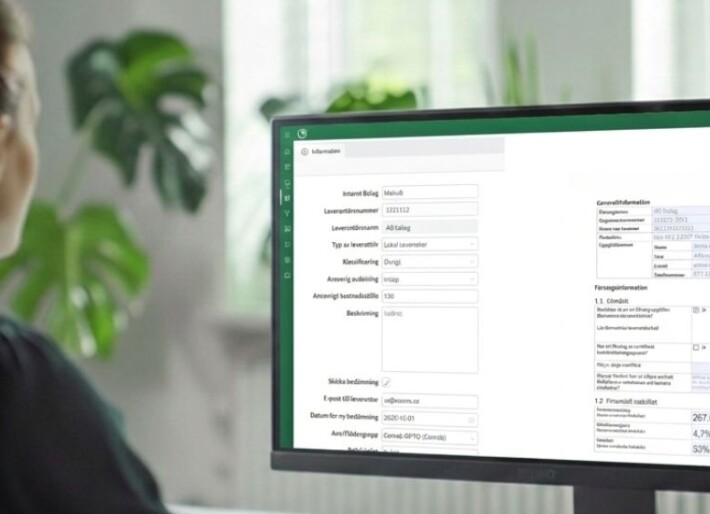
We decided to build the feature directly into Conrab Opto instead. The user clicks “reject” in the same view where the invoice is already being reviewed. Conrab Opto then forwards the information to the customer’s e-invoice provider, which in turn is responsible for reporting it to the French authorities.
From the user's perspective, there's no difference from handling any other invoice. One click, and it's done.

Imagine an accounting assistant who processes hundreds of invoices each week. One of them is not to be paid. If that person then has to remember to open another website, log in there, and make the same assessment all over again, the risk is obvious—either that step is forgotten entirely, or it takes an unnecessarily long time and creates a bottleneck in the workflow.
We are not replacing the e-invoice provider—they continue to perform their duties for the French authorities just as they did before. What we are building is a bridge between the day-to-day workflow at Conrab Opto and that system, so that users never have to handle reporting manually in a separate interface.
This is not only relevant for companies operating in France. Several other countries are introducing similar requirements for reporting financial transactions—or equivalent requirements when an invoice is not to be paid in different phases and with different details—but based on the same fundamental principle.
The principle behind the solution—eliminating the need for unnecessary system changes when new regulatory requirements are introduced—is therefore relevant to more of our customers, regardless of the country. If you operate in multiple countries, there is a high probability that you will encounter the same type of requirements again, just in a different form.
The feature is built as part of the platform, not as a one-time solution for a single customer. This means we can now offer the same functionality to more customers who handle invoicing in France, without having to rebuild it from scratch every time a new company has the same requirements.
That’s our philosophy through and through: when a regulatory requirement changes, we don’t just want to address it for one customer at a time. We want to build a solution that will stand the test of time when the next customer—or the next country—imposes the same type of requirement.
The biggest compliance risks rarely lie in the major, obvious requirements—but rather in the small, easily overlooked steps that require someone to actively go the extra mile. By building the rejection feature directly into Conrab Opto, we have solved an urgent problem for our customers, while also creating a solution that can be scaled to serve more customers and comply with the regulations of more countries.
Affected companies must be able to receive e-invoices through an approved operator (PA) and report financial transactions to the French authorities, including cases where an invoice is not to be paid.
Yes. The rules require active reporting even when a received invoice is rejected or not paid, not just upon approval and payment.
Yes, with the right integration. At Conrab Opto, we've built the rejection feature directly into the standard workflow, so users don't have to log in separately with the e-invoice provider.
Several countries are introducing or planning similar requirements for e-invoicing and transaction reporting. The principle of active reporting—even for rejected invoices—is becoming increasingly common within the EU.
Please get in touch with us, and we'll tell you more about how we can help you.
Conrabs' case management system adapts to your workflows—whether you're handling 5 or 50 different types of cases.
Want to know more?
The most comprehensive system on the market
Want to know more?