Peppol invoice:
How It Works and What to Expect in 2027


How It Works and What to Expect in 2027
A Peppol invoice is a structured XML invoice sent via an international network—not a PDF that must be interpreted manually. It arrives directly, is machine-readable, and is ready to be posted in the recipient’s system.
Many finance departments still receive invoices via email, scan them, and enter them manually. It feels safe. Familiar. But requirements are changing. E-invoicing via Peppol is already a legal requirement for the public sector, and now the same requirements are being extended to business-to-business transactions: The EU is making e-invoicing the primary option by 2030, and a Swedish report is scheduled to be completed in November 2027.
In this article, we’ll go over how the network works, how a Peppol invoice differs from a PDF, how to get a Peppol ID, and what to expect legally. We’ll also discuss the risks associated with automation, why invoices are rejected—and how to get started without having to rush through a last-minute adaptation later on.
Peppol is an international network for sending structured business documents, particularly electronic invoices. It is based on a common standard that enables companies and government agencies to exchange documents regardless of which financial system they use or which country they are located in.
The standard format is called Peppol BIS Billing 3. It complies with the European standard EN 16931 and is managed by the OpenPeppol organization.
In practice, this means you don’t have to sign a contract with each individual provider. The network is based on a four-corner model in which the invoice travels through certified access points —not directly between you and the sender.
Here's what the workflow looks like:
No party needs an agreement with any other party. The access points handle the routing, and a receipt is sent back immediately upon receipt of the invoice.
Today, there are two common ways to receive invoices: PDF invoices and e-invoices via Peppol. They may look the same on the surface, but they work very differently in practice.
A PDF invoice is an image format. It must be interpreted manually or scanned using OCR, which leaves room for errors and duplicate work.
A Peppol e-invoice is structured data that flows directly into the system and can be posted automatically.
It is also worth distinguishing Peppol from older operator networks. A traditional VAN operator or EDI solution required bilateral agreements between each party that was to exchange invoices. Peppol eliminates that requirement—a single network, no point-to-point connections.
And the PDF approach doesn't work all the way anymore.
For invoices to the public sector that are subject to the E-Invoicing Act, PDF or scanned invoices do not count as e-invoices.
Furthermore, the old Swedish standard, Svefaktura, is being phased out; the recommendation for Svefaktura 1.0 was withdrawn as early as April 1, 2021.
A Peppol ID is the unique address that identifies you on the network—so that invoices reach the right destination. Without it, no sender knows where to send the invoice.
The structure is simple: a four-digit prefix that specifies the type of identifier, followed by the number itself. For Swedish limited liability companies, partnerships, and government agencies, the prefix 0007 is used, followed by the organization number, without a hyphen.
There is one important detail to note for sole proprietorships. Since a sole proprietorship uses the owner’s personal identification number as its business registration number, that number will be publicly listed in the global registry if you register with the prefix 0007.
The solution is a GLN number through GS1, which is registered under the prefix 0088. This protects your personal identification number while ensuring you meet the requirements. It’s a small step that saves you from unnecessary exposure.
Before you send a Peppol invoice, you need to know the recipient's Peppol ID, which you can look up in the official registry.
The global registry is called the Peppol Directory. Digg also has a Swedish search service for organizations affiliated in Sweden.
When your access point needs to send an invoice, it looks up the registry to find the correct recipient—all of this happens behind the scenes.
The network is already large. In Sweden, there are about 156,000 registered participants, and globally, over 4.5 million.
Before you send your first invoice:
E-invoicing via Peppol has been a legal requirement for the public sector since 2019 —but the major shift is that the requirement is now extending to transactions between businesses.
The EU's ViDA package was adopted in March 2025. This means that electronic invoicing will become the legally mandated default option for transactions covered by ViDA as of July 1, 2030. At the same time, near-real-time digital reporting will be introduced for cross-border business-to-business transactions within the EU.
In Sweden, a commission was established in February 2026. Among other things, it will assess whether mandatory e-invoicing should also apply to domestic transactions between businesses and is scheduled to report its findings in November 2027.
Other countries are leading the way. Here is the timeline:
The fact that the transition is already underway is evident up close. In the spring of 2025, the Swedish Customs Service fully transitioned to Peppol for its customs invoices, and the older XML support is gone. Those who haven’t made the switch will receive invoice data on paper instead of directly into their system.
More than 95 percent of Swedish public sector entities are already connected. Those who make the switch now will avoid a rushed transition later.
Peppol is marketed as secure, and technically that’s true. But trust has shifted—from the document itself to the identity behind it. That’s where the problem lies.
If an access point has inadequate controls when accepting new customers, someone could register using another company’s information. It would then be possible to send technically correct but commercially fraudulent invoices over the network.
The scary part? You receive a delivery receipt confirming that the invoice has been delivered safely. And that receipt can lull you into a false sense of security—the invoice has been delivered in accordance with the regulations, but the sender isn’t who you think it is.
The second risk lies in the automation. When incoming invoices are scanned, approved, and posted without anyone reviewing them, a legal vulnerability arises.
An invoice that is not disputed within a reasonable time may be considered approved. If the system automatically posts an incorrect invoice, this can be interpreted as tacit approval—and then it becomes more difficult to dispute it later. The Accounting Act and commercial law set requirements, but it is the failure to raise an objection that creates the problem.
It's not about distrusting automation. It's about maintaining control where it matters: control over who sends messages, control over what you approve, and control over when you dispute them.
A workflow that catches discrepancies before they are posted is not a bottleneck. That is the difference between managing the workflow and being managed by it.
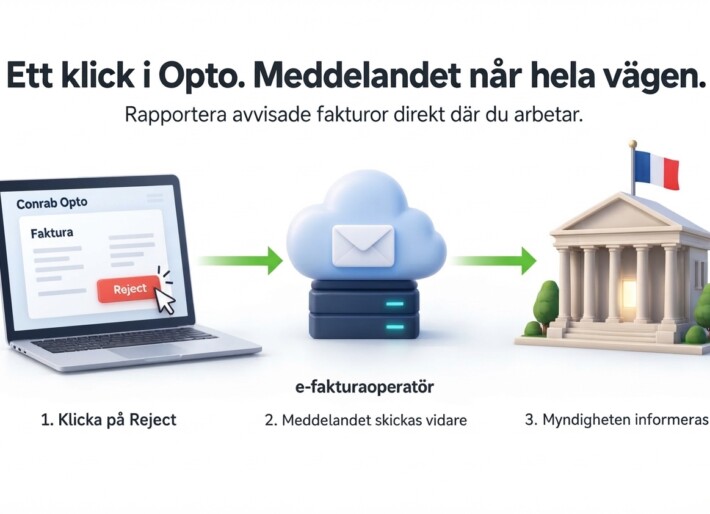
A Peppol invoice is usually rejected because it fails validation against the standard’s rules—and the error can almost always be corrected at the source. The access point validates the invoice against EN 16931 right at the network boundary and sends back an error message immediately.
That's an advantage. The invoice is returned immediately, not three weeks later when someone realizes it got stuck. The error is caught while it's still easy to correct.
Most rejections are due to the same handful of reasons. The European standard is stricter than the old Swedish formats, especially at the line level. Information that could previously be omitted must now be included. The best way to avoid errors is to fill in the information correctly from the start.
To get started, you'll need three things: an access point, a registered Peppol ID, and correctly filled-in fields. The rest is just configuration.
This is what the process looks like regardless of the ERP system—the principle is the same:
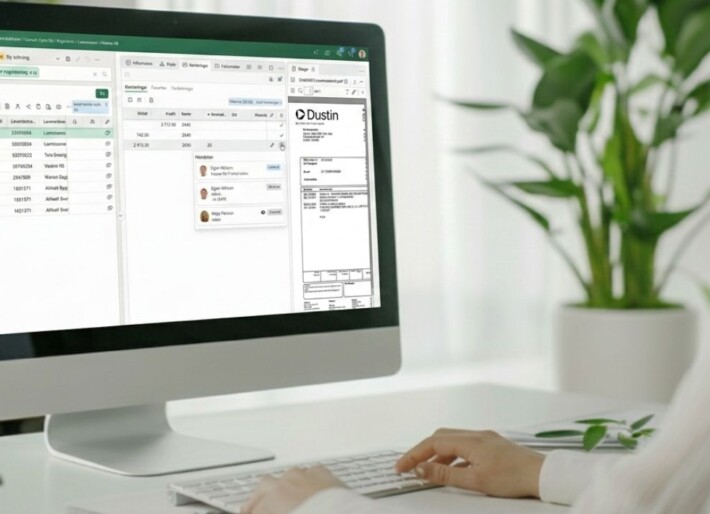
The point is to receive invoices directly in the system, already validated and ready to process. That way, you can focus on the workflow instead of data entry. If you’d like to learn more, there’s a guide on how to choose and implement an EFH system while avoiding the most common pitfalls.
The Peppol standard itself does not require a license fee. However, access points and business systems charge different rates for connections and transactions, and that is where the cost lies.
Where is the money? Often in three places:
It is precisely these unit costs that represent an invisible drain on resources. Individually, they are small, but they add up across thousands of invoices, and few people actually track them.
Compare that to the cost of manual processing. With structured e-invoice processing, the administrative burden associated with invoices can be reduced by up to 80 percent.
The first step isn't to calculate the cost of a system. It's to figure out how much the manual workflow is already costing you.
Traditional operator networks such as EDI required bilateral agreements between each party that needed to exchange invoices. Peppol eliminates that—a single network with structured data, where all participants can reach each other without point-to-point connections.
A Peppol ID is registered through an access point. Corporations and government agencies use the prefix 0007 followed by their organization number. Sole proprietorships should obtain a GLN number through GS1 and register it under the prefix 0088, so that the personal identification number is not publicly visible in the registry.
This is already a legal requirement for the public sector. For transactions between businesses, the issue is currently under review in Sweden, with a report due in November 2027. Within the EU, e-invoicing will become the primary option as of July 1, 2030, and several neighboring countries are moving ahead—Belgium starting in 2026 and Norway requiring e-invoicing starting in 2027.
Almost always due to validation errors. The most common ones are a missing buyer reference, a missing VAT category at the line level, and units of measure specified in free text instead of a standard code. The error is sent back immediately, so it can be corrected at the source.
Not for the public sector—PDFs are completely rejected there, since a PDF is not considered an e-invoice in Peppol. It still works between businesses for now, but with ViDA on the way, PDFs and scanned invoices will be phased out as valid options.
The standard itself does not incur any licensing fees. The cost depends on which access point you choose and how your business system prices connections and transactions. Some systems include Peppol support as part of the subscription.
It’s not about introducing yet another system. It’s about gaining control—before the requirements between companies become a reality.
Those who make the switch in time will enjoy a daily life that runs more smoothly, with greater peace of mind and better conditions for making the right decisions.
Get in touch, and we’ll show you how to implement digital supplier invoice processing with less manual work, better control, and a faster path from invoice to approval.
You don't have to change everything all at once. But you can start by getting an overview.
Conrabs' case management system adapts to your workflows—whether you're handling 5 or 50 different types of cases.
Want to know more?
The most comprehensive system on the market
Want to know more?